Ecosystem Deep Dive
Mangroves
The ocean's armor. Carbon vaults of the sea. Nurseries for half the world's fisheries. In one generation, we've destroyed a third of them.
What Are They
Trees that conquered the sea
Mangroves are a group of roughly 80 tree species that have evolved to live in the intertidal zone — where ocean meets land, where saltwater floods roots twice a day, and where most other trees would die within hours. They do this through extraordinary adaptations: prop roots that breathe through the mud, salt-filtering systems in leaves, and seeds that germinate while still attached to the parent tree.
They exist along tropical and subtropical coastlines on every continent except Europe and Antarctica. The greatest diversity lives in Southeast Asia — the Coral Triangle — where decades of shrimp farming has already eliminated over half of historic cover.
Where mangroves grow, life follows. Their submerged root systems are among the most productive habitats on Earth — nurseries for fish, crabs, and shrimp that feed billions of people, shelter for endangered species that evolved nowhere else, and a first line of defense for 300 million people living in flood-prone coastal areas.
Why They Matter
Six roles. No substitutes.
Coastal Armor
Mangrove roots dissipate wave energy by up to 70%, protecting coastlines from storm surge, tsunamis, and erosion. A 100-meter wide mangrove belt can reduce wave height by half. Every hectare of mangrove forest saves an estimated $65,000/year in storm damage. As sea levels rise and storms intensify, they are the most cost-effective coastal defense on the planet — and we're destroying them faster than we can plant them.
Blue Carbon Giant
Mangroves store between 1,000 and 2,500 tonnes of carbon per hectare — far exceeding tropical rainforests. Unlike terrestrial forests, they store the bulk of this carbon in waterlogged soils that may not release it for thousands of years. When cleared, this "blue carbon" is released rapidly, making mangrove destruction one of the most intense point sources of greenhouse gas emissions on Earth.
Fishery Nursery
More than 80% of the world's tropical fish species spend part of their life cycle in mangrove forests. The interlocking prop roots create labyrinthine nurseries where juvenile fish, shrimp, and crabs shelter from predators and find food. Globally, mangroves support fisheries worth over $50 billion annually. When mangroves are lost, the entire marine food chain upstream is weakened — from village fishing boats to oceanic ecosystems.
Sediment Filter
Mangrove root networks trap land-based sediments and nutrients before they reach coral reefs and seagrass beds. Without this filter, coral systems — already stressed by warming — are suffocated by algae fed by agricultural runoff. Entire reef systems depend on mangrove buffer zones. Remove the mangroves, and the reef follows within years.
Human Livelihood
Over 100 million people live within 10 km of mangrove forests. They rely on them for food, timber, medicine, and storm protection. Mangrove-dependent communities — particularly in Bangladesh, Indonesia, India, and West Africa — face compound crises when forests are destroyed: lost fisheries, collapsed coastal defenses, and cultural displacement. The communities with the smallest carbon footprints pay the highest price for global deforestation.
Biodiversity Hotspot
Despite covering less than 0.5% of Earth's surface, mangrove forests host extraordinary biodiversity. Bengal tigers in the Sundarbans hunt between tidal channels. Proboscis monkeys exist only in Borneo's mangroves. Hundreds of migratory bird species stop in mangrove estuaries during their annual journeys. The irreplaceable fauna of mangroves cannot simply relocate — when the forest goes, so does the species that evolved alongside it.
The Crisis
What's destroying them
At current rates of loss, virtually all accessible mangrove forests could be eliminated within 100 years. The drivers are well understood — and largely driven by policy choices, not necessity.
Aquaculture Conversion
38% of lossesShrimp and fish farms are the leading cause of mangrove destruction globally, particularly in Southeast Asia. A single shrimp pond destroys multiple hectares of mangrove — and is typically abandoned after 5–10 years as soil acidifies, leaving a wasteland.
Coastal Development
25% of lossesTourism infrastructure, port development, and urban expansion destroy mangroves for hotels, roads, and industrial facilities. These losses are permanent — developed land is rarely restored.
Deforestation for Timber & Charcoal
20% of lossesMangrove wood is dense and burns hot. In many countries, it is harvested for construction timber and charcoal at rates that far exceed regrowth, particularly in West Africa and South Asia.
Agricultural Runoff
12% of lossesNitrogen and phosphorus from upstream agriculture cause algae blooms in mangrove estuaries, suffocating root systems and reducing the dissolved oxygen that mangrove-dependent fish need to survive.
Sea Level Rise
5% of lossesClimate change accelerates sea level rise faster than mangroves can migrate inland. In areas where development blocks inland movement, mangroves are drowned between rising seas and human-built infrastructure.
Global Hotspots
The world's last great mangrove systems
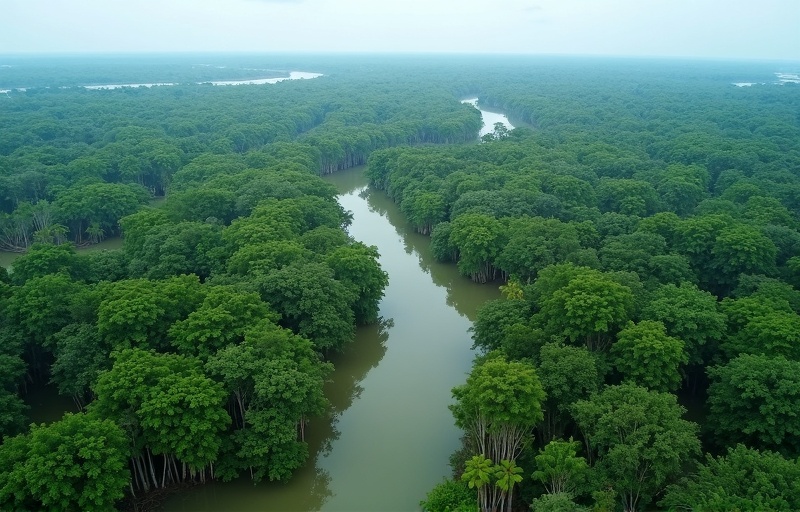
Sundarbans
CriticalIndia & Bangladesh
10,000 km²
Home to Bengal tigers, largest single mangrove forest in the world, losing 200 ha/year.
Coral Triangle Mangroves
ThreatenedIndonesia, Philippines, Malaysia
~6 million hectares
Contains 35% of all global mangroves. Over half has been cleared for shrimp farming since 1980.
Mesoamerican Reef Mangroves
ThreatenedMexico, Belize, Honduras
190,000 hectares
Protect the second-largest coral reef on Earth. Under pressure from resort development and sea level rise.
Mangroves can be restored. But only if we act now.
Community-led restoration programs have replanted millions of mangrove trees at less than $1 per tree. The cost of inaction — in storm damage, lost fisheries, and released carbon — is orders of magnitude higher.